- +91-9930498858Call / WhatsApp
- [email protected]Email Us
Precision-manufactured utilizing advanced multi-axis CNC punching, fiber laser profiling, and deep-drawing presses. Explore our top wholesale product lines engineered for heavy processing, chemical distillation, and automated storage.
A comprehensive technical evaluation of metallurgical properties, structural load calculations, and mechanical precision in industrial screening applications.
Perforated screen plates serve as the foundational mechanical separation and structural interface across mineral processing, refining columns, wastewater dewatering, aggregate screening, and heavy industrial acoustic mitigation. The functional efficacy of a screen plate is governed by the hydraulic kinetics of the media, the open area percentage ($\%OA$), the die-clearance ratio, and the structural rigidity of the unperforated margins. When evaluating perforated media from a Chinese manufacturing facility, engineers must assess not only dimensional tolerances but also microscopic grain deformation, work-hardening rates along the sheared aperture edges, and residual stress distributions induced during high-speed CNC pressing.
The mechanical integrity of perforated plates relies heavily on the ligament width—the minimum distance of solid metal between adjacent punched apertures. A common failure mode in vibrating screen decks and high-pressure distillation column sieve trays is fatigue fracturing across adjacent ligaments caused by harmonic cycling or hydraulic flutter. Selecting the optimal hole arrangement directly dictates hydrodynamic resistance, particulate blinding propensities, and structural longevity:
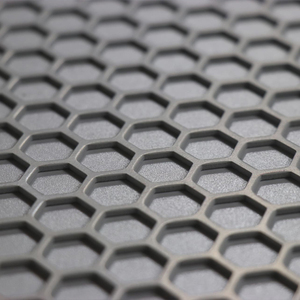
The global engineering standard for structural screening. Provides optimal ligament efficiency and uniform strength in all shear planes. Calculates as $\%OA = \frac{D^2 \times 90.69}{C^2}$, maximizing structural strength while delivering up to 74% open area.
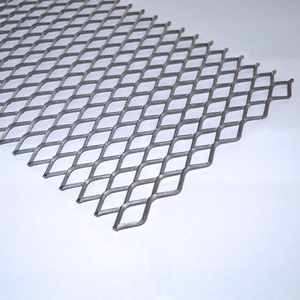
Engineered for aggregate grading, grain sifting, and high-throughput slurry dewatering. Slotted configurations reduce particulate pegging and blinding by offering elongated release paths along downstream flow gradients.
Features tapered aperture profiles punched with specialized progressive dies. The widening outlet on the discharge side eliminates particulate wedging in high-viscosity food and fine chemical filtration processes.
Material selection must be cross-referenced with abrasive media indices, operating chemical pH, chloride thresholds, and cyclic thermal operating limits. Sourcing perforated plates requires precise mill cert validation (EN 10204 3.1) to ensure the sheet alloy matches tensile yield requirements and corrosion resistance criteria:
| Alloy Specification | Yield Strength (MPa) | PREN Rating | Primary Industrial Application | Failure Mode Safeguard |
|---|---|---|---|---|
| AISI 304 / 304L | ≥ 205 | 18.0 - 20.0 | General food processing, decorative panels, architectural cladding | Intergranular corrosion resistance via low carbon chemistry |
| AISI 316 / 316L | ≥ 220 | 23.0 - 25.0 | Petrochemical trays, marine filtration, pharmaceuticals | Molybdenum addition resists localized pitting attack in chloride media |
| Duplex 2205 (UNS S32205) | ≥ 450 | 35.0 - 38.0 | Mining vibrating decks, oil & gas separators, desulfurization units | Double the yield strength of austenitic SS; high stress corrosion cracking immunity |
| Hastelloy C-276 | ≥ 355 | ≥ 68.0 | Wet chlorine scrubbers, sour gas, hot organic acids | Resists severe crevice corrosion and pitting in oxidizing/reducing streams |
| Hardox 450 / 500 Carbon Alloy | ≥ 1200 | N/A | Aggregate trommels, coal sorting, heavy mineral screening | Extreme through-thickness hardness mitigating abrasive slurry wear |
In wholesale industrial screen plate fabrication, punch tooling clearance represents the critical variable determining edge quality. An inadequate die clearance induces excessive micro-cracking and high burr heights, while excessive die clearance produces plastic deformation drag and plate cupping. Our facilities calculate die clearances precisely via the formula:
$Clearance (c) = t \times \sqrt{\tau / 100}$ | where $t$ = sheet thickness, $\tau$ = shear strength of base alloy
All perforated panels undergo precision roller leveling to eliminate residual stresses caused by localized elongation during punching. Final processing includes automated multi-brush rotary deburring, passivation pickling (ASTM A967), or electropolishing to remove micro-burrs and restore the passive chromium oxide protective layer.
Strategic analysis for enterprise procurement managers, EPC contractors, and global supply chain directors navigating industrial screen plate sourcing over the next decade.
Increasing demand for aperture diameters under 0.5mm punched into heavy gauge plates (hole-to-thickness ratio $d/t < 1$). Driven by high-purity API chemical synthesis, advanced hydrogen fuel cell diffusion layers, and sub-micron particulate filtration.
Global procurement teams are shifting away from initial purchase price toward lifecycle longevity. Specifying Duplex 2205 or tungsten-carbide coated screen plates cuts unscheduled plant outages by over 60%, drastically reducing downtime costs in continuous mining and refining operations.
Cross-border procurement now mandates complete raw material mill certification, green steel declarations (Scope 1 and Scope 2 emissions), and ultrasonic non-destructive testing (NDT) documentation for mission-critical pressure vessel internals.
How automation, high-power fiber laser systems, and hybrid tooling are redefining perforated plate manufacturing limits.
Modern 20kW+ fiber laser heads allow cutting of heavy plate up to 25mm thick with tapered kerf profiles, allowing complex geometric perforations previously unachievable with mechanical tooling.
Replaces traditional hydraulic ram presses with servo-electric drives, delivering programmable punch depths, reduced edge micro-fracturing, and tighter pitch pitch accuracy (±0.05mm).
High-precision 21-roller reverse-bending levelers eliminate internal compressive stresses created during hole displacement, ensuring absolute flatness tolerances under 1.5mm/m².
Application of Physical Vapor Deposition (PVD) titanium nitride or ceramic composite surfacing to perforated plates increases wear endurance by 300% in highly abrasive mineral screening environments.
Leveraging over two decades of dedicated fabrication excellence, our manufacturing facilities integrate full-cycle production: from raw coil decoiling, high-speed CNC pressing, multi-axis laser cutting, and deep drawing to roll-bending, seam welding, and surface finishing. Serving EPC contractors and OEMs in more than 20 countries across North America, Europe, Australia, and the Middle East, our production lines ensure full engineering compliance with ASTM, DIN, and ISO standards.
Authoritative technical guidance compiled by our chief metallurgical and tooling engineers to streamline your procurement specifications.
In standard punch pressing, the rule of thumb is $d/t \ge 1.0$ for mild steel and aluminum, and $d/t \ge 1.2$ for austenitic stainless steel. However, utilizing our heavy-duty CNC presses equipped with specialized tungsten punch tooling and nitrogen-assisted cooling, we can punch micro-apertures down to a $d/t$ ratio of 0.8. For requirements where the hole diameter is smaller than the plate thickness ($d/t < 0.8$), we recommend fiber laser profiling or photo-chemical etching.
Punching displaces substantial volumes of metal, introducing tensile stresses across the perforated zone while the solid margins remain under compression. To deliver flat screen plates, our factory integrates an automated 21-roller precision leveler immediately downstream of the punching press. Plates undergo controlled cyclical reverse-bending under continuous tension, yielding flatness tolerances within ±1.5mm per meter squared.
Yes. Every screen plate order is programmed via CAD/CAM to your exact dimensional drawings. We incorporate unpunched perimeter margins, solid internal support rib areas, countersunk mounting bolt holes, clamping notches, and alignment dowel slots. This ensures modular drop-in fitment into existing vibrating screen decks, trommel frames, or column tray support rings.
Standard export consignments include: (1) EN 10204 3.1 Material Test Certificate covering heat chemistry and mechanical yield/tensile values; (2) Detailed CMM dimensional inspection report confirming hole pitch, diameter, and squareness; (3) Surface roughness inspection certificates; and (4) Fumigation and ISPM-15 compliance certifications for all wooden crates.
While woven wire mesh provides higher initial open area percentages for ultra-fine particle separation, perforated screen plates deliver substantially higher structural stiffness, impact resistance, and operational lifespan. Perforated plates prevent wire shifting, maintain precise aperture geometry throughout abrasive material impacts, and can be fabricated with variable thickness up to 20mm to resist severe mineral loads.
Tooling design and prototype validation typically require 5 to 7 working days. Full wholesale production runs (10 to 100 metric tons) generally ship within 15 to 25 days depending on base alloy availability and downstream operations (such as forming, roll-bending into trommel cylinders, or pickling/passivation). Accelerated expediting schedules are available for critical maintenance outages.
Connect directly with our applications engineering department. Submit your CAD drawings, required aperture geometries, and operating conditions to receive an itemized manufacturing quotation and comprehensive product catalog within 24 hours.