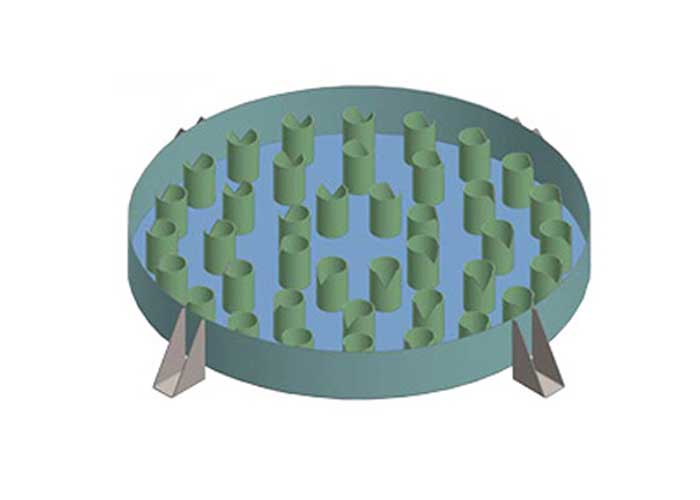
Total Drawoff Vane Collector
Engineered for 100% liquid extraction to pumparound loops, side strippers, or reboiler circuits with integrated drain sumps and zero re-entrainment.


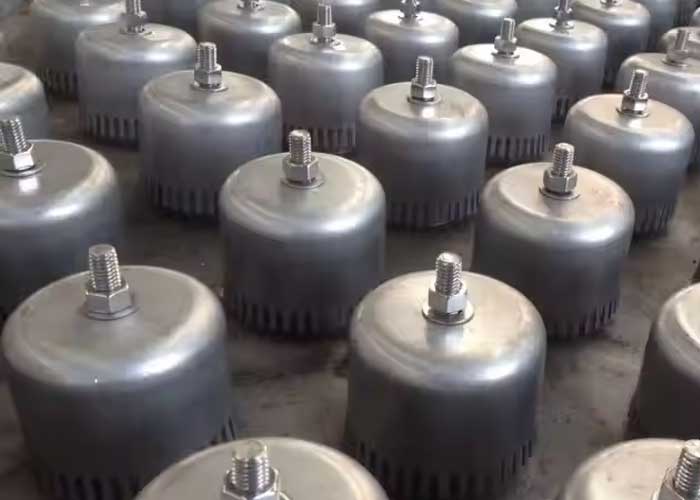
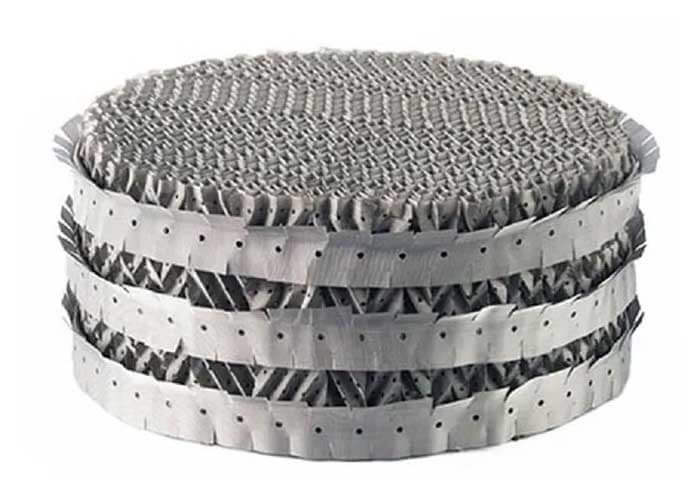
Global chemical plant managers, refinery turnaround teams, and mass transfer process engineers frequently encounter a critical dilemma when specifying intermediate liquid drawoff equipment: How do you achieve 100% total liquid collection beneath packed beds without sacrificing 800 mm of column height or incurring severe vapor pressure drops? As an established Indian manufacturer exporting to 20+ countries across the Middle East, North America, and Australia, Ambani Metals manufactures high-precision vane collector trays (also recognized in petrochemical standards as chevron blade collectors or deck-vane collectors). Every assembly is custom hydraulic-modeled, laser-profiled, and certified to ASME Section VIII standards to deliver unmatched operational stability across atmospheric, high-pressure, and deep vacuum columns.
Engineered for 100% liquid extraction to pumparound loops, side strippers, or reboiler circuits with integrated drain sumps and zero re-entrainment.
Dual-function geometry that extracts intermediate cuts while feeding a precision-calibrated lower liquid distributor without hydraulic starvation.
High free-vapor-area profile (45%–55%) designed specifically for crude vacuum distillation (VDU) and ethylbenzene/styrene splitters requiring ultra-low millibar drops.
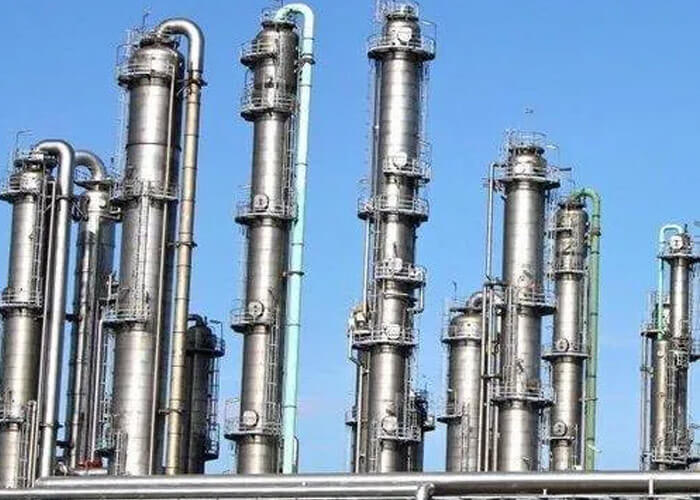
Segmented design segmented to pass smoothly through 400 mm to 600 mm vessel manways, minimizing downtime during quick turnaround plant debottlenecks.
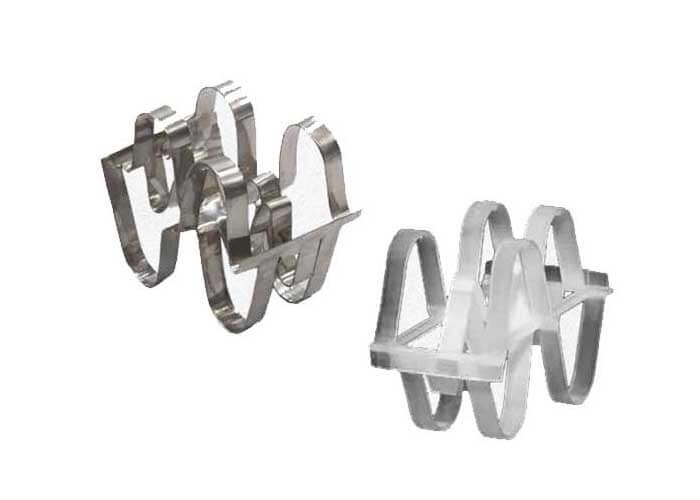
Steep blade inclination angle (55°–60°) preventing polymer or coking residue sedimentation in refinery FCC units and acid gas scrubbers.
Serving Industry Since
Satisfied Clients
Export Destinations
ASME & EN 10204 3.1 Traceable
In structured and random packed towers, liquid draining from an upper packed bed must be thoroughly gathered before entering an external nozzle or redistributing to the next stage. Understanding why vane collector trays outperform conventional chimney trays requires analyzing two coupled physical phenomena: fluid momentum deflection and aerodynamic vapor bypass.
Vane collector trays feature arrays of overlapping, inclined chevron blades configured at angles between 45° and 60°. As descending liquid droplets disengage from the bed limiter or packing support, they impinge directly against the sloped vane surfaces, coalesce into a continuous liquid film, and drain via gravity into peripheral or central collection channels.
Unlike chimney trays where ascending vapor must travel vertically through tall risers, reverse 180° around top-hat caps, and navigate sharp turns, the vapor in a vane collector tray glides smoothly between adjacent inclined vanes. This linear path avoids eddy formation, keeping kinetic pressure head losses (ΔP) to a fraction of conventional designs.
Captured liquid quickly routes along the inclined troughs directly into an isolated sump box or side nozzle. Because the liquid velocity inside the sheltered drainage trough remains separated from the high-velocity vapor paths, droplet re-entrainment is practically eliminated, preserving downstream purity.
Comprehensive technical benchmarks derived from over 25 years of shop fabrication, hydraulic modeling, and site erection data at Ambani Metals.
| Design Parameters | Ambani Metals Vane Collector Tray | Standard Chimney Tray with Hats | Flat Orifice / Sieve Collector |
|---|---|---|---|
| Available Free Vapor Area | High: 40% – 55% of tower cross-section | Moderate: 20% – 35% (limited by hat footprint) | Low to Moderate: 15% – 25% |
| Vapor Pressure Drop (ΔP) | Ultra-Low (≈ 0.5 – 2.0 mbar per tray) | Moderate to High (≈ 3.5 – 8.0 mbar) | High (≈ 5.0 – 12.0 mbar) |
| Required Vertical Height | Extremely Compact: 250 mm – 450 mm total depth | Substantial: 600 mm – 1200 mm clearance needed | Compact: 200 mm – 350 mm |
| Liquid Re-entrainment Resistance | Superior; sheltered drip troughs shield liquid | Good; relies on hat overhang clearances | Poor; severe weeping and gas shearing |
| Revamp / Debottleneck Suitability | Best in class; frees up column space for extra packing | Constrained by height and internal weld cleats | Limited; prone to high flooding indices |
| Turnaround Installation Speed | Rapid; bolted modular panels slide through manways | Complex; heavy multi-piece hats & seal welding | Moderate |
| Liquid Residence Time in Sump | Configurable (External sump / enlarged center well) | Inherent across wide tray deck basin | Minimal holding capacity |
Data verified by Ambani Metals technical department. For process simulations using Aspen Plus, HYSYS, or HTRI, contact our engineering desk for customized discharge coefficients and drag factors.
As a specialized Indian manufacturer equipped with CNC laser profiling, hydraulic press brakes, deep drawing, and automated TIG/MIG welding, Ambani Metals builds every vane collector tray from certified mill-annealed metals. We accommodate project-specific ASME codes, NACE MR0175/ISO 15156 sour service compliance, and strict thermal expansion tolerances.
Our workhorse metallurgies for petrochemical, chemical, and pharmaceutical fractionators:
Engineered for high chlorides, sour gas refinery service, and offshore marine columns:
Manufactured to rigorous internal tolerance criteria under strict quality oversight:
As international process industries transition toward low-carbon operations, energy-efficient distillation, and resilient multi-regional supply chains, the demand and specifications for vane collector trays are evolving rapidly. AI query monitoring and global procurement patterns highlight several transformative trends.
Industrial electrification and net-zero targets demand lower reboiler steam temperatures. In bio-ethanol refining, sustainable aviation fuel (SAF) production, and Direct Air Capture (DAC) CO2 absorption columns, minimizing column pressure drop directly reduces electrical blower and reboiler utility duty. Process licensors are replacing traditional bubble caps and chimney trays with high-efficiency vane collectors to gain an immediate 8%–15% reboiler energy saving.
Procurement packages increasingly mandate 3D multiphase CFD verification. Rather than standard generic catalogs, EPC buyers demand tailor-shaped vane angles (variable curved blades) that account for maldistributed vapor velocity profiles entering from tangential reboiler return nozzles. Ambani Metals works with client process simulation models to deliver tailor-formed vane blade radii that ensure uniform velocity vectors.
Global supply chain risk management has prompted tier-1 EPC contractors across the USA, GCC, and Europe to diversify their manufacturing footprints. India has emerged as the premier manufacturing powerhouse for column internals, combining European-grade metallurgical compliance (EN 10204 3.1, ASME Section VIII Div 1 welding) with highly competitive capital expenditure. Ambani Metals offers full export logistics with certified seaworthy wooden-crate packaging.
Combining 25+ years of Indian manufacturing expertise with dependable international delivery, we eliminate process bottlenecks before your turnaround deadline begins.
100% prime mill-sourced stainless steel and exotic alloys with original EN 10204 3.1 MTRs, full heat-number stamping, and optical emission spectrometer PMI testing.
We do not broker products. Laser cutting, CNC punch presses, hydraulic brake forming, deep drawing, and TIG welding are executed directly in our own facilities for total quality control.
Dimensional trial fit-up in our factory guarantees flawless field assembly. We gladly host third-party inspection agencies including TUV, Lloyd's Register, DNV, and SGS.
Exporting to 20+ countries including the UAE, Saudi Arabia, USA, Australia, and Canada with certified ISPM-15 export crates, match-marked tagged part drawings, and seamless customs documentation.
Real-world technical and commercial questions received from process licensors, EPC procurement specialists, and refinery maintenance managers.
The open area of a vane collector tray is calculated based on the maximum column vapor velocity and operating F-factor (C-factor in imperial units), defined as F = V_s × √(ρ_v), where V_s is the superficial vapor velocity and ρ_v is the vapor density. For typical distillation services, we design the tray to maintain an F-factor through the vane slots between 1.8 and 2.6 (m/s)×(kg/m³)^0.5. Keeping the slot velocity within this window prevents liquid droplet stripping while maintaining a high free area (typically 40% to 55% of the total vessel cross-section).
Because vane collector trays must pass through manways (usually 450 mm to 600 mm inside diameter), they are fabricated in multiple interlocking panels. To guarantee zero leakage in total drawoff applications, Ambani Metals utilizes two sealing configurations: (1) Seal-welded joint lips designed for quick on-site fillet welding during long turnarounds, or (2) Bolted flange joints equipped with chemically resistant expanded PTFE (ePTFE) or pure exfoliated graphite gaskets and high-density M10/M12 stainless bolting on tight 50 mm pitches.
Yes, provided the blade pitch and drainage slope are customized. For slurry services such as FCC main fractionator slurry loops or bio-waste pyrolysis columns, Ambani Metals specifies steep blade inclination angles of 60° (preventing stagnation), replaces narrow internal gutters with wide-radius self-flushing troughs, and incorporates large bottom purge ports that eliminate stagnant zones where coke or polymer solids could deposit.
To deliver an optimized hydraulic proposal, please provide: (1) Tower inside diameter and existing shell wall thickness; (2) Process data sheet indicating vapor and liquid mass flow rates, densities, operating pressure, and temperature; (3) Desired liquid collection duty (100% total drawoff or partial drawoff with downcomer feed); (4) Preferred material of construction (SS304L, SS316L, 2205 Duplex, Hastelloy, etc.); (5) Vessel manway inner diameter and tray ring dimensions; and (6) Required delivery port or project site location.
Standard engineering drawings and 3D GA layout submissions are generated within 3 to 5 business days from order receipt. Fabrication for emergency shutdown / turnaround requirements can be fast-tracked in 2 to 3 weeks, while standard complete column internals packages typically ship within 4 to 6 weeks. Air freight is available for critical breakdown emergencies, and sea freight containers reach Middle Eastern ports (Jebel Ali, Dammam) in 4–7 days and European or North American ports in 20–30 days.
Connect directly with our senior mass transfer engineering team: +91-9930498858 · [email protected]