- +91-9930498858Call / WhatsApp
- [email protected]Email Us
Delivering high-ratio length-to-diameter geometry, monolithic joint-free integrity, and tight dimensional repeatability across micro-precision and heavy-duty cylindrical bodies.
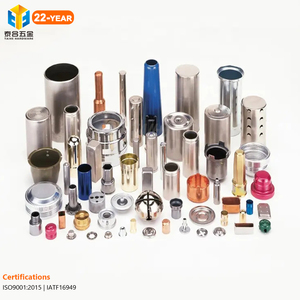
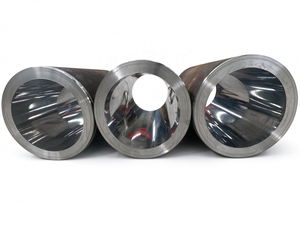
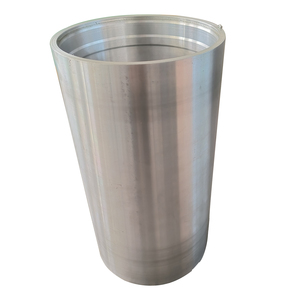
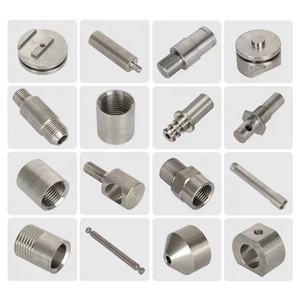
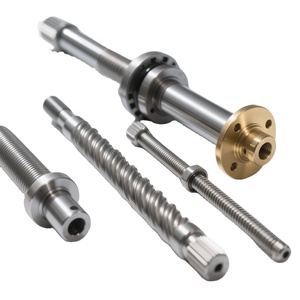
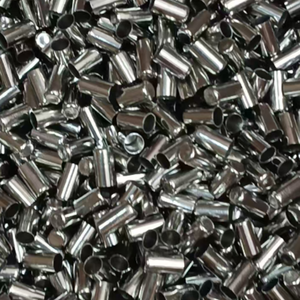
Why Tier-1 engineering teams and OEMs transition from CNC hog-outs and rolled-and-welded sleeves to cold-formed deep drawn seamless cylinders.
Unlike roll-formed and welded sleeves, progressive deep-drawn cylinders begin life as a single circular metallic blank. By avoiding secondary seams, weld bead porosity, thermal heat-affected zones (HAZ), and joint crystallization, the resulting shell provides flawless containment for pressurized hydraulic, pneumatic, and ultra-high-vacuum environments.
During the radial-draw and iron-forming stages, the crystal lattice of austenitic stainless steels, copper, and specialty alloys reorganizes along axial streamlines. This cold plastic deformation yields exceptional work hardening, dramatically elevating the tensile and burst threshold while enabling thinner wall thicknesses and reduced component mass.
Through carbide draw rings and optimized lubrication dynamics, cylinder interior walls routinely achieve unmachined surface finishes under Ra 0.4 µm. This is essential for clean-in-place (CIP) pharmaceutical canisters, frictionless pneumatic piston bores, and particle-free cryogenic or high-purity laboratory containers.
Precision mechanical properties tailored across broad alloy specifications, including exotic refractory formulations.
| Material Specification | Primary Alloying Bases | Drawing Ratio (L/D) | Typical Surface Finish | Core Target Applications |
|---|---|---|---|---|
| Austenitic Stainless | SUS304, 304L, SUS316, 316L | Up to 4.5:1 (Multi-stage) | Ra 0.2 - Ra 0.4 µm | Medical canisters, chemical processing shells, vacuum housings |
| Engineering Carbon Steel | ST52, E355, 16Mn, Q345B, 1045 | Up to 6.0:1 (Cold drawn/ironed) | ISO H8, Ra ≤ 0.4 µm | Hydraulic barrel tubes, heavy shock cylinders, pressure sleeves |
| Non-Ferrous Alloys | Aluminum 1050/6061, C26000 Brass, Cu-ETP | Up to 3.8:1 | Ra 0.15 - Ra 0.3 µm | Electronic sensor cans, solenoid valves, heat sink tubes |
| Refractory & Superalloys | Niobium ASTM B394, Hastelloy, Monel | Specialized hot/warm draw | Ra 0.4 - Ra 0.8 µm | Chemical crucibles, high-temperature furnace liners, acid systems |
A whitepaper briefing on technological evolution, structural light-weighting, and global vendor footprint consolidation.
The manufacturing floor has shifted away from traditional hydraulic stroke presses to multi-axis CNC servo presses. Servo-actuated kinematics allow customized speed and tonnage curves across the drawing stroke, reducing internal stress, limiting thin-out at cylinder radii, and eliminating intermediate annealing cycles to compress production timelines.
With volatile nickel, copper, and molybdenum costs, procurement executives increasingly value deep-draw processes over billet machining. While subtractive CNC milling can scrap up to 70% of high-grade raw alloys, progressive deep-draw cylinder forming reaches scrap rates below 12%, drastically lowering part weight and product cost for large-volume OEM contracts.
Sourcing strategies now strongly favor tier-1 suppliers capable of delivering ready-to-assemble sub-systems. Manufacturers that combine progressive tooling with precision necking, reverse beading, bottom piercing, CNC flange trimming, laser drilling, and ultrasonic passivating allow buyers to cut vendor fragmentation and supply chain risk.
Decades of industrial capability, accredited quality systems, and worldwide export readiness.
Every cold-formed cylinder, honed tube, and deep-drawn shell is mapped directly to certified primary mill melt logs. Raw materials are verified by optical emission spectrometry, and shipments come with complete EN 10204 3.1 Material Test Certificates (MTC), mechanical stress results, and chemical trace analyses.
Tool design is our core intellectual property. Equipped with slow-speed wire EDM, multi-axis high-speed CNC machining centers, and carbide surface lap polishing, our dedicated toolroom designs, simulates (FEA forming limit diagrams), tests, and maintains progressive die tooling in-house to protect production continuity.
We verify cylinder wall uniformity, bottom-thickness preservation, straightness, ovality, and surface profile using Zeiss CMMs, non-contact optical video measurement, ultrasonic wall gauges, and hydrostatic/helium leak testing stations to maintain zero defect escapes at dispatch.
Technical guidance for design engineers, purchasing managers, and QA auditors.
In a standard single-action press draw, the limiting draw ratio (LDR) typically ranges from 1.8 to 2.1 depending on alloy ductility and n-value (strain-hardening exponent). However, using multi-station progressive dies, telescoping transfer toolsets, and intermediate controlled-atmosphere induction annealing, we regularly deliver cylinder depth-to-diameter ratios exceeding 4.5:1 to 6.0:1 without tensile necking or surface micro-cracking.
Wall reduction occurs naturally near the bottom radius as metal bends over the punch. We control this by designing custom punch-to-die clearances, optimizing blank holder blanking pressures via nitrogen cushion cylinders, and introducing ironing stages that smooth and stabilize wall thickness along the full height of the cylindrical shell.
Please share your 2D engineering drawings (PDF/DWG format specifying ID/OD tolerances, concentricity, minimum bottom and side wall thicknesses, internal corner radii, and acceptable surface roughness Ra) along with 3D models (STEP/IGES), material specifications, annual forecast volumes, and end-use application parameters (e.g., pressure, vacuum, or chemical exposure).
Yes. Beyond standard austenitic 300-series stainless steels, structural carbon steels (E355, ST52, 42CrMo), and aluminum alloys, our metallurgical and forming engineers process refractory and special metals including ASTM B394 Niobium, pure Nickel (Ni200/201), Hastelloy, Monel, and Titanium for high-temperature research, chemical reactors, and semiconductor processing chambers.
Every deep-drawn cylinder and honed barrel undergoes cleaning and passivation, followed by volatile corrosion inhibitor (VCI) anti-rust bagging, custom partition trays to prevent metal-to-metal contact, and reinforced fumigated export-grade plywood crates engineered to handle moisture, vibration, and multi-modal transit to North American, European, and Australian ports.
Connect directly with our engineering team for DFM reviews, forming simulations, tooling feasibility analysis, and commercial quotations tailored to your exact bill of materials.
Contact Us