- +91-9930498858Call / WhatsApp
- [email protected]Email Us
Explore our turnkey product lineup spanning sintered porous tubes, stainless wire gauze structured packing, and precision industrial enclosures engineered to ASTM, DIN, and ISO standards.
A rigorous metallurgical overview of industrial filtration mechanisms, pressure drop optimization, and precision weaving specifications for process engineers and EPC procurement teams.
Industrial wire mesh filtration is not merely a physical sieving operation; it is an engineered balance of pore geometry, fluid mechanics (Darcy's Law for porous media), surface cake build-up kinetics, and corrosion resistance. In critical chemical, refinery, and pharmaceutical applications, selecting the wrong wire diameter, weave type, or alloy grade leads to premature blinding, structural fatigue under reverse backwash pulses, or catastrophic product contamination. Ambani Metals leverages over 25 years of fabrication expertise to engineer woven mesh, multi-layer sintered laminates, and structured wire gauze that guarantee precise micron cut-offs and maximum hydraulic throughput.
From Square Plain Weave for linear sieving to Twilled Dutch (DTW) and Reverse Dutch Weave (RDW), structural wire orientation determines both absolute retention rating (down to 1μm) and mechanical tensile tolerance under cyclic forward-reverse flows.
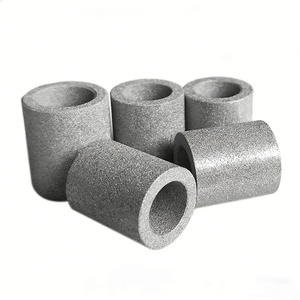
Pore Size: 1μm – 1000μmBy diffusion-bonding woven wire mesh layers under vacuum at sub-melting metallurgical temperatures, individual wire migration is completely eliminated. The resulting monolithic structure withstands extreme continuous operating pressures up to 300 bar.
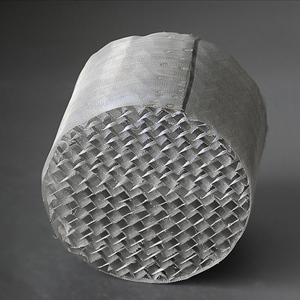
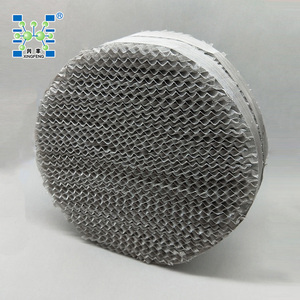
Zero Fiber SheddingSpecialty corrugated wire gauze internals, including standard BX (500 m²/m³) and CY (700 m²/m³) geometric surface configurations, utilize capillary liquid film spreading to minimize theoretical stage height (HETP) during deep vacuum fractional distillation.
Low ΔP per StageSelect the optimal woven wire filtration architecture based on your process viscosity, particulate load, and hydrodynamic operating parameters.
| Weave Pattern | Pore Geometry & Flow Path | Filtration Range (μm) | Mechanical Rigidity | Primary Industrial Use-Cases |
|---|---|---|---|---|
| Plain Square Weave | Straight-through square apertures; uniform 2D aperture. | 25μm – 2000μm | Moderate; flexible in thin wire diameters. | Solid-liquid separation, classification, polymer screens, vibrating sieves. |
| Plain Dutch Weave (PDW) | Dense warp, heavier shute wires driven tightly; triangular fluid channels. | 15μm – 150μm | High directional stability; deformation resistant. | High-pressure hydraulic return lines, fuel filtration, fuel injector strainers. |
| Twilled Dutch Weave (TDW) | Warp/shute wires pass 2-over, 2-under; maximum wire pack density. | 1μm – 40μm | Exceptional burst pressure tolerance. | Sub-micron liquid filtration, pharmaceutical crystallization, gas purification. |
| Reverse Dutch Weave (RDW) | High count warp wires, heavier shute wires; warp creates aperture. | 10μm – 120μm | Superior longitudinal mechanical strength. | Continuous polymer ribbon screen changers, sand control screens, high backwash systems. |
| 5-Layer Sintered Laminate | Protective mesh, control mesh, buffer layer, and 2 structural support meshes. | 0.5μm – 100μm | Maximum monolithic structural integrity. | Fluidized beds, chemical reactor spargers, flare gun anti-tempering flame arrestors. |
Ambani Metals manufactures woven and sintered filter media across a comprehensive spectrum of ferrous and superalloy materials certified to international mill standards.
Low-carbon stainless grades preventing intergranular sensitization during welding or sintering. 316L adds 2-3% Molybdenum for improved chloride pitting and general crevice corrosion protection.
Standard DutyNickel-molybdenum-chromium alloy engineered with tungsten. Delivers unmatched corrosion resistance to wet chlorine gas, hypochlorite, sulfur compounds, and aggressive organic acid media.
Severe ChemicalMonel (Ni-Cu) thrives under rapid-velocity marine seawater, hydrofluoric acid alkylation, and brine. Inconel 625 resists thermal stress cracking and cyclic oxidation up to 980°C.
Offshore & ThermalGrade 1 and 2 Titanium provide exceptional weight-to-strength ratios and passivity against oxidizing nitric acid. Pure Nickel (Ni-200/201) serves caustic alkali manufacturing and chlor-alkali cells.
Electrochemical / AlkaliHow green hydrogen electrolyzers, advanced carbon capture systems, and additive manufacturing are reshaping B2B filtration specifications.
The rapid scale-up of Proton Exchange Membrane (PEM) and Alkaline water electrolysis requires zero-leaching, high-purity porous transport layers (PTL). Suppliers must furnish ultra-clean titanium mesh, platinum-coated surfaces, and pure nickel foam elements capable of sub-surface gas-liquid micro-bubble disengagement without ionic degradation of fragile catalytic membranes.
Global EPC contractors and pharmaceutical operators now demand complete digital chain-of-custody documentation. Procurement contracts increasingly require automated Positive Material Identification (PMI) spectral logs, continuous laser-scan bubble point testing records (ASTM E128), and full heat-number traceability mapped directly to raw master coils.
Industrial filtration is transitioning from conventional welded flange connections to hybrid structures combining Direct Metal Laser Sintering (DMLS) end-caps with precision woven or sintered mesh tubes. This eliminates heat-affected-zone (HAZ) stress cracking, minimizes hydrodynamic dead zones, and improves clean-in-place (CIP) efficiency in sterile active pharmaceutical ingredient (API) filtration loops.
Combining integrated metallurgy, precision tooling, and global export compliance to streamline technical filtration procurement.
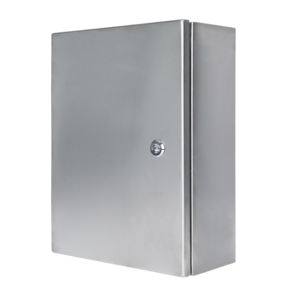
Complete single-source fabrication under one roof: CNC laser cutting, precision metal stamping, multi-stage deep drawing, and automated seam welding maintain dimensional tolerances within ±0.05mm across volume runs.
Rigorous quality protocols adhering to ASTM E2016-20 (industrial woven wire cloth specifications) and ISO 16889 multi-pass filtration performance testing. Every batch ships with certified EN 10204 3.1 MTRs.
Exporting seamlessly to more than 20 countries, including the United States, UAE, Saudi Arabia, Australia, and Canada. Standardized ISPM-15 heat-treated crating ensures zero cargo damage during deep-sea transport.
Direct communication with qualified process metallurgists and mechanical engineers. We review differential pressure (ΔP) budgets, chemical attack profiles, and column hydraulic drawings prior to committing to production.
Direct technical answers to common questions raised by plant engineers, quality managers, and international supply chain directors.
Nominal ratings estimate the approximate aperture size, but absolute ratings are confirmed via standardized testing methods. Ambani Metals conducts Bubble Point Testing compliant with ASTM E128 and ISO 4003, as well as glass bead challenge tests and microscopic optical digital image analysis to determine the precise micron cut-off rating under hydraulic conditions.
Standard woven mesh consists of interlocking wires held in place by friction; under excessive differential pressure or backwash pulses, individual wires can shift, altering pore apertures. Sintered mesh undergoes a high-temperature diffusion-bonding vacuum cycle that fuses the wire contact points, preventing pore distortion, wire shedding, and media channeling under extreme operational loads.
Structured wire gauze packing (such as 250AX, 500BX, and 700CY) is chosen for deep vacuum distillation, fine chemical fractionation, and thermal-sensitive separations (e.g., essential oils, pharmaceuticals). Due to capillary liquid action across the fine wire gauze, it delivers a very low HETP (Height Equivalent to a Theoretical Plate) and an extremely low pressure drop per stage compared to random rings.
While 304 and 316 stainless steels perform well in benign aqueous services, chloride-rich brine or seawater environments require higher Pitting Resistance Equivalent Numbers (PREN). For such applications, Ambani Metals specifies and fabricates filters in Hastelloy C-276, Monel 400, or Super Duplex alloys, supplemented by complete post-weld passivating and pickling treatments.
To produce an accurate technical quotation and manufacturing blueprint, please provide: the operating fluid composition, flow rate, continuous operating pressure, maximum differential pressure (ΔP), operating temperature range, required micron cut-off (absolute or nominal), connection style (NPT, BSP, flange, sanitary tri-clamp), and CAD drawings or dimensional sketches.
Cleanability is primarily determined by surface smoothness and pore channel shape. Reverse Dutch Weave (RDW) and smooth-surfaced sintered laminate plates allow rapid dislodging of accumulated filter cake during reverse pulse-jet or ultrasonic cleaning cycles, significantly extending the service life between maintenance turnarounds compared to depth fiber media.
Submit your operating parameters, process data sheet, or custom drawing to our metallurgy and mass transfer engineering team for rapid quotation and technical review.