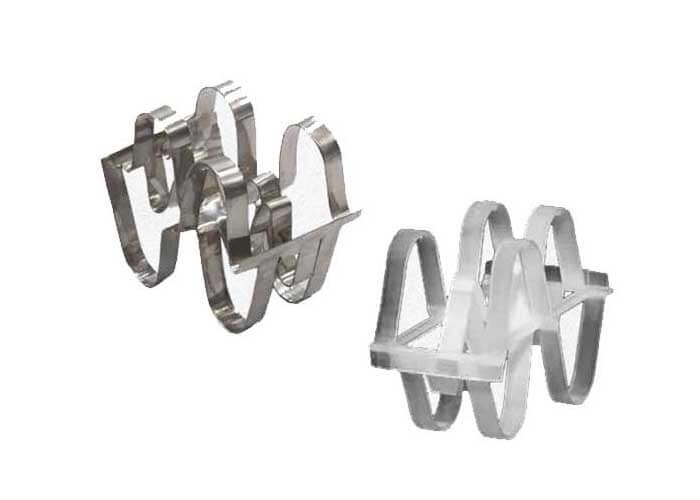
Pall Rings
Equipped with internal radial fingers and windowed outer walls, Pall rings deliver up to 50% lower pressure drop and higher capacity than traditional smooth cylinders.
SS304 / SS316L High Gas Velocity

Backed by over 25 years of metallurgical precision and chemical processing expertise, Ambani Metals manufactures and exports high-performance random packing elements for fractionation, sour gas stripping, industrial scrubbers, and vacuum distillation columns. Engineered to provide maximum active surface area per cubic meter while maintaining an open void geometry, our random packings significantly decrease bed pressure drops, prevent premature liquid holdup, and mitigate fouling risks in harsh continuous processes.
Equipped with internal radial fingers and windowed outer walls, Pall rings deliver up to 50% lower pressure drop and higher capacity than traditional smooth cylinders.
A proven, dependable cylindrical design offering strong structural rigidity and predictable mass transfer rates in standard chemical absorption and acid recovery systems.
Next-generation ring architecture with curved open-lattices providing superior mechanical resistance against compression and outstanding vapor passage stability.
Low aspect-ratio ring with contoured flanges encouraging preferred planar orientation when dumped, reducing flow turbulence and drag significantly.
Non-nesting saddle contour providing balanced contact angles and steady surface renewal, minimizing dry patches along the perimeter of the packed section.
Scalloped outer ridges promote rapid droplet detachment, increasing liquid renewal rates and theoretical stage efficiency (HETP) for demanding separation.
Internal cross-partition configuration delivering immense crushing strength and exceptional inertness against harsh sulfuric, nitric, and hydrochloric acids.
Specialty curved and expanded geometry offering uniform boundary layers and low liquid retention for high vacuum revamps and heat-sensitive distillation.
Operating conditions, corrosion indexes, chemical media, and operating temperatures govern packing longevity. Ambani Metals stamps, draws, and machines random packing from prime certified materials accompanied by complete EN 10204 3.1 Mill Test Reports.
Grades: SS 304/304L, SS 316/316L, 321, Duplex 2205, Super Duplex, Hastelloy C276, Inconel 625, Monel 400, Titanium Grade 2, and Carbon Steel.
Advantages: Thin-walled profiles provide supreme void fractions (>96%), high mechanical impact resistance, and unlimited operational temperature limits in refinery hydrocarbon units.
Grades: Polypropylene (PP), Reinforced Polypropylene (RPP), PVDF, PTFE, ETFE, and CPVC.
Advantages: Highly economical and lightweight solution offering virtually total chemical inertness against saline solutions, wet chlorine, caustic stripping, and environmental flue gas scrubbing up to 140°C.
Grades: Chemical-grade stoneware, acid-proof technical porcelain.
Advantages: High structural integrity and thermal resistance exceeding 800°C. Unaffected by concentrated mineral acids (except hydrofluoric acid), making them standard in chlor-alkali and thermal oxidizer beds.
Evaluate hydraulic traits, turndown limits, and fouling endurance to specify the ideal mass transfer internals for your plant turnaround or greenfield vessel design.
| Packing Type | Dominant Material | Specific Surface Area (m²/m³) | Void Fraction (%) | Relative Pressure Drop | Fouling Tolerance |
|---|---|---|---|---|---|
| Metal Pall Rings (25mm / 1") | SS304 / SS316L / Hastelloy | 210 – 230 | 95 – 97% | Low | High |
| Metal Pall Rings (50mm / 2") | SS304 / SS316L / Carbon Steel | 110 – 125 | 97 – 98% | Extremely Low | Very High |
| Cascade Mini Ring (#2 / #3) | SS316L / Inconel / Monel | 160 – 215 | 96 – 98% | Very Low | High |
| Intalox / Ceramic Saddles (1") | Chemical Porcelain / PP / PVDF | 250 – 290 | 72 – 88% | Moderate | Moderate |
| Super Raschig Ring (1.5") | Stainless Alloys / Duplex | 135 – 155 | 97 – 98% | Ultra Low | Maximum |
| Structured Corrugated Sheet | SS304 / SS316L Sheet | 250 – 500 | 93 – 97% | Minimal (ΔP/stage) | Low (Clean Fluids Only) |
Random packing efficiency is fundamentally dependent on precise initial liquid distribution. Even the highest-grade Pall ring or saddle bed will suffer efficiency collapse if liquid channeling occurs. Ambani Metals supplies fully engineered column internals configured specifically to your vessel nozzle layout and design flow rates.
Trough, perforated pipe-arm, and pan-orifice distributors engineered to provide upwards of 100 to 150 drip points per square meter, eliminating dry channeling across deep packed depths.
High-open-area beam and multi-chordal support trays designed with separate gas-riser chimneys and liquid-drain slots to prevent premature hydrodynamic flooding at the bottom support plane.
Rigid alloy grid structures installed directly over the top of dumped packing beds to prevent element dislocation, thermal expansion lifting, and entrainment during sudden gas surges.
Ambani Metals routinely supplies turnarounds, refinery revamps, and new plant projects with scheduled container shipments, custom seaworthy palletization, and full international documentation compliance.
Saudi Arabia (SABIC, Aramco spec compliance), United Arab Emirates (Dubai, Abu Dhabi), Qatar, Oman, Kuwait, Bahrain, Egypt, and Jordan.
United States, Canada, Mexico, Brazil, Germany, United Kingdom, France, Italy, Belgium, Spain, Netherlands, Poland, and Sweden.
Singapore, Malaysia, Indonesia, Thailand, South Korea, Japan, Australia, New Zealand, South Africa, Nigeria, Ghana, and Kenya.
Key technical insights addressed by our mass transfer chemical engineers and fabrication specialists.
Random packing consists of discrete, geometrically engineered shapes (such as Pall rings, Raschig rings, or saddles) dumped randomly into a mass transfer column. These elements provide a high specific surface area and continuous void fraction, maximizing vapor-liquid contact while minimizing pressure drop across the packed bed.
While Raschig rings have solid cylindrical walls, Pall rings incorporate radial internal tabs and stamped perimeter windows. This allows rising gas and descending liquid to circulate inside and outside the ring, which decreases pressure drops by up to 50% and dramatically increases hydraulic capacity and mass transfer rates.
Random packing is the preferred technical choice for applications containing moderate suspended solids, fouling fluids, or corrosive chemical streams where structured packing corrugations could become plugged. It also offers lower capital expenditure (CAPEX), rapid installation through existing manways, and simple bed dumping during turnarounds.
A fundamental chemical engineering guideline dictates that the column internal diameter (D) should be at least 8 to 10 times greater than the nominal diameter (d) of the random packing (D/d ≥ 8). Ratios lower than 8 result in severe liquid wall flow (channeling), leaving the center of the bed starved of liquid and drastically hurting overall fractionation efficiency.
High-grade alloy packings (such as stainless steel, Hastelloy, or Inconel) can frequently be unloaded, chemically washed, acid pickled, and re-screened to remove debris before reloading. However, in applications where severe scale deposition has occurred, replacement is often more cost-effective to guarantee original design hydraulic performance.
Yes. As an integrated manufacturer, we design and produce complete internal packages—including multi-trough gravity liquid distributors, gas injection support plates, bed limiters, and mesh demisters to ensure balanced hydraulic continuity across your column vessel.
Submit your process data sheet, chemical composition, or vessel dimensions directly to our engineering team for immediate technical review and competitive global quotations.
Inquire Now