- +91-9930498858Call / WhatsApp
- [email protected]Email Us
Direct-from-factory solutions engineered for optimal gas-liquid contact, minimal differential pressure, and rigorous mechanical resilience across critical operational columns.
Review comprehensive hydraulic ratings, mesh density specifications, and multi-alloy chemical compatibility charts. Download our full CAD library and factory export dossier today.
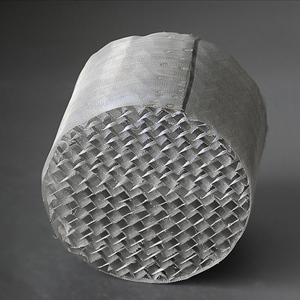
The operating principle of industrial wire mesh demisters relies fundamentally on mechanical inertial impaction, direct interception, and centrifugal coalescing. When a two-phase vapor-liquid stream ascends through a high-porosity matrix (typically 97.0% to 99.2% void fraction), vapor flows smoothly around the rounded filaments while entrained liquid droplets, possessing superior momentum, cannot negotiate the tortuous streamline deflections. Consequently, droplets collide with the metallic wires, adhere via surface tension, coalesce into a continuous liquid film, and drain downward against the ascending vapor stream by gravity once the liquid droplet mass overcomes the opposing kinetic shear forces.
The baseline sizing of mist elimination devices is mathematically expressed by the classical Souders-Brown velocity equation:
Where Vmax represents the maximum permissible superficial vapor velocity before liquid re-entrainment ensues, ρL and ρV define liquid and vapor phase densities under operating temperatures and pressures, and K is the empirical systemic capacity factor (typically ranging from 0.07 to 0.12 m/s depending on crimp angle, mesh bulk density, surface tension, and liquid viscosity). Exceeding Vmax results in severe droplet stripping from downstream wire surfaces, leading to re-entrainment and dramatic separation efficiency degradation. Conversely, operating significantly below design velocity allows ultra-fine droplets to bypass filaments via streamline tracking.
| Demister Profile / Configuration | Bulk Density (kg/m³) | Surface Area (m²/m³) | Free Voidage (%) | Target Droplet Cutoff (d99) | Typical Industrial Application |
|---|---|---|---|---|---|
| Standard Industrial (SS 304/316L) | 120 – 144 | 280 – 350 | 98.2% | ≥ 5.0 μm | Refinery crude vacuum columns, knock-out drums, steam drums |
| High-Efficiency Fine Mesh | 190 – 240 | 450 – 620 | 97.1% | ≥ 2.5 μm | Amine contactors, natural gas dehydration, high-purity distillation |
| High-Throughput Open Weave | 80 – 96 | 180 – 220 | 99.0% | ≥ 10.0 μm | Heavy slurry scrubbing, high-fouling flue gas desulfurization (FGD) |
| Co-Knitted Dual Phase (Metal + PTFE) | 160 – 210 | 500 – 780 | 97.5% | ≥ 1.0 μm | Aerosol mist elimination, ultra-pure chemical processes, acid gas plants |
| Dual-Stage Chevron Vane + Mesh Pad | Custom Composite | Combined Assembly | Variable | ≥ 3.0 μm (High Liquid Load) | High-liquid slug knock-out vessels, offshore topside separators |
By interleaving multifilament hydrophobic or hydrophilic polymers (such as PTFE, PVDF, or ETFE) directly alongside corrosion-resistant metallic filaments (SS316L, Hastelloy, Monel), modern mesh pads capture sub-micron mist particles via Brownian diffusion without causing disproportionate pressure drop spikes.
Next-generation demister pads incorporate graduated density zoning. A coarse, open weave at the vapor inlet coalesces primary liquid slugs, while successively denser micro-mesh layers downstream polish fine droplets, drastically extending bed life and mitigating liquid re-entrainment under surge conditions.
To address harsh refinery catalytic cracking units and chloride-rich petrochemical streams, specialized surface treatments and refractory exotic alloys (Niobium, Tantalum, Inconel 625, Hastelloy C-276) prevent scale nucleation, stress corrosion cracking, and premature operational fouling.
Procurement paradigms for process column internals are undergoing systemic shifts. Modern engineering, procurement, and construction (EPC) firms, alongside major international refiners, demand more than standard commodity pricing. Procurement decision-making has transitioned toward full lifecycle Total Cost of Ownership (TCO) assessments, automated quality verification, and rapid turn-around emergency revamp capabilities:
For over a quarter of a century, our manufacturing facilities have engineered and delivered advanced mass transfer internals, column trays, and knitted wire products to global refinery, petrochemical, and industrial chemical facilities. With a direct presence across more than 20 export destination countries—including the UAE, Saudi Arabia, the United States, Australia, and Canada—our operations bridge metallurgical precision with industrial-scale cost efficiencies.
All austenitic stainless steels, nickel alloys, and refractory materials originate from premier certified raw mills. Each production run includes physical tensile verification, chemical spectrometry, and formal 3.1 inspection documentation.
From precision wire drawing and knitting machines to specialized deep-drawing presses and fiber laser cutting stations, our complete in-house fabrication loop guarantees micrometer-level mechanical tolerances across all grid sections and vessel diameters.
Every column internal order is carefully packed in heavy-duty, fumigated, seaworthy timber cases. Modular sectors carry engraved identification plates, clear orientation tagging, and hardware bundles for error-free installation during field turnarounds.
To execute an accurate hydrodynamic sizing calculation, our engineering team requires: operating pressure and temperature, vapor volumetric flow rate (or mass flow rate), vapor density (ρV), liquid density (ρL), liquid surface tension, operating fluid viscosity, entrained liquid loading (g/m³ or wt%), target separation cutoff micron size, and maximum permissible differential pressure drop (ΔP). Vessel ID and manway clear opening dimensions are also necessary to divide the pad into practical segmented sections.
Knitted wire mesh pads are ideal for fine mist removal (droplets down to 2–5 microns) under moderate liquid loadings and clean services. However, if the process stream exhibits high liquid loadings (> 100 liters/m³/hr), elevated operating velocities, high viscosity, or contains suspended solids/particulates prone to plugging fine wire matrices, a vane-type chevron mist eliminator is preferred. Vane packs handle up to 4 times higher liquid slugs with substantially lower fouling risks.
Demister mesh pads cannot self-support their weight across vessel diameters. They require rigid structural open grids (constructed from flat bar and round bar welded in a grid layout). Typically, a bottom support grid carries the dead weight plus hydrostatic liquid hold-up, resting on a welded vessel support ring. A top hold-down grid prevents pad uplift caused by gas surges. The mesh sections are secured to these grids using heavy-gauge stainless steel tie wires or dedicated J-bolts.
While standard SS 304/304L is economical for clean, neutral organic vapors, and SS 316/316L is standard for mild chemical and vacuum distillation, severe environments require higher metallurgy. For wet chlorine, hydrochloric acid, and sulfurous gases, we manufacture demisters in Hastelloy C-276. For offshore marine, high-brine, or hydrofluoric acid applications, Monel 400 is specified. For caustic alkali environments, pure Nickel 200/201 is deployed, while Titanium Grade 2 is utilized for extreme chloride resistance.
Standard diameter segmented pads in SS304/316L are typically manufactured within 7 to 14 business days following approval of general arrangement drawings. Custom alloy fabrications (Hastelloy, Inconel, Titanium) or complex dual-stage vane-mesh assemblies generally ship within 3 to 4 weeks. Emergency expedited turnaround schedules are routinely coordinated for unexpected refinery shutdowns and turnarounds.
Send us your column diameter, operating conditions, or equipment data sheet. Receive a full mechanical proposal, hydrodynamic sizing calculation, and direct factory export quotation within 24 hours.