- +91-9930498858Call / WhatsApp
- [email protected]Email Us
Explore our precision-fabricated mass transfer packing media, chemical distillation rings, and deep-drawn metal packaging products. Each configuration is optimized for operational reliability, maximum specific surface area, and chemical corrosion resistance.
A rigorous examination of fluid dynamics, hydraulic capacities, and corrosion-resistant metallurgy for plant debottlenecking and column revamps.
In modern chemical processing, continuous distillation, scrubbing, and petrochemical fractionating, metal random packing acts as the operational workhorse for phase equilibrium. Unlike structural packing, which relies on rigid geometrical crimping, random packing relies on the stochastic dumping of precision-stamped metallic geometries into a packed bed column. This generates dynamic interfacial contact surfaces that balance low pressure drop with intense vapor-liquid mixing.
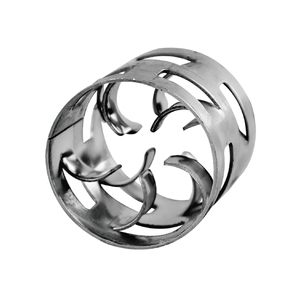
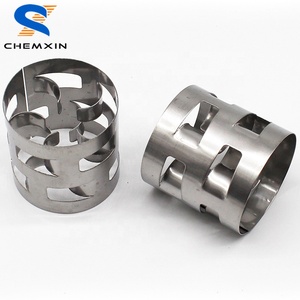
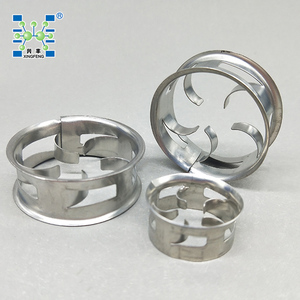
Modern column designs require balancing high hydraulic loading without reaching premature entrainment flooding. By transitioning from traditional Raschig rings to slotted, inner-curved geometries like Pall rings and low-aspect-ratio Cascade Mini Rings (CMR), chemical processing engineers achieve significant mass transfer efficiency gains. The internal tabs, openings, and reduced vertical wall heights lower resistance to upward vapor flow, while liquid forms an active, continuously shearing film over both exterior and interior alloy surfaces.
| Packing Media | Hydraulic Capacity | Specific Surface Area | Fouling Resistance | Optimal Service Environment |
|---|---|---|---|---|
| Metal Raschig Ring | Baseline | Moderate (80–200 m²/m³) | Moderate | Low-cost revamps, carbon capture scrubbers, non-critical gas washes. |
| Metal Pall Ring (SS304/316) | +25% to 40% vs. Raschig | High (110–240 m²/m³) | High (low stagnation) | Atmospheric and vacuum distillation, sour water stripping, chemical absorbers. |
| Cascade Mini Ring (CMR) | +40% to 55% vs. Raschig | Exceptional (130–280 m²/m³) | Superior (open aspect ratio) | High-throughput fractionators, high-pressure amine contactors, refinery debottlenecking. |
| Metal Dixon Gauze Rings | Ultra-Low ΔP per theoretical stage | Maximum (>500 m²/m³) | Low (Requires clean feed) | Laboratory distillation columns, isotope purification, high-value API batch separation. |
Shifts in global procurement protocols are redefining how process engineers and EPC contractors source distillation internals.
Global refineries are transitioning toward high-nickel austenitic stainless steels (316L, 904L, Inconel, and Hastelloy). With increasingly sour crude feeds, standard SS304 packing is systematically replaced with dual-certified pitting-resistant alloys to prevent stress corrosion cracking (SCC) and unscheduled unit shutdowns.
Procurement departments are shifting away from traditional 1:1 aspect-ratio rings. Modern tower revamps specify lower aspect-ratio elements, like Cascade Mini Rings, where vertical orientation minimizes projected frontal area against vapor streams, unlocking 15% to 20% column throughput expansion without civil structure rebuilding.
Global supply chain risks have made uncertified bulk metals obsolete. Tier-1 buyers demand EN 10204 3.1 certification, complete Positive Material Identification (PMI) using X-ray fluorescence, and certified stamped wall thicknesses to ensure structural integrity across thermal loading cycles.
How precision stamping, surface texturing, and digital modeling drive mass transfer performance.
State-of-the-art random packing incorporates micro-embossing and selective wall perforations. Rather than depending on basic capillary action, micro-textured surfaces improve liquid film stability, mitigating premature dry-spot channeling across high surface-tension systems.
By leveraging advanced multiphase Eulerian-Eulerian CFD simulations, modern packing geometries are designed to eliminate recirculation eddy zones. The resulting profiles decrease static liquid holdup, lower fouling accumulation, and improve the Height Equivalent to a Theoretical Plate (HETP).
Automated progressive die pressing eliminates micro-burrs and edge fractures in high-temper alloys. Clean-cut interior arches enhance operational strength during column bed settlement, ensuring resistance to deformation under dynamic liquid and vapor surges.
Combining metallurgical expertise, in-house deep-drawing tooling, and end-to-end export quality assurance.
Raw coil stocks are sourced exclusively from top-tier mills. Every production run undergoes spectrographic composition checks, tensile testing, and wall-thickness micrometric verification to guarantee performance in harsh process environments.
Our facility houses high-tonnage progressive presses, deep-drawing stations, and specialized stamping lines. This integrated setup allows custom wall-thickness tolerances, proprietary dimensions, and rapid tooling modification without external delays.
Our experienced process engineering team analyzes your operational data—including gas density, liquid surface tension, flooding limits, and turndown targets—to recommend the ideal packing profile and calculate exact bed volume needs.
Random packing is securely packed in reinforced wooden crates, moisture-sealed multi-wall drums, or heavy-duty woven bulk bags. All consignments feature detailed part tags and fumigation documentation to ensure smooth port customs clearance.
Essential guidance for column designers, procurement officers, and plant turn-around supervisors.
Raschig rings are hollow metal cylinders that offer straightforward surface area, but can suffer from vapor bypassing and interior liquid stagnation. Pall rings solve this by pressing internal curved finger tabs inward from the cylinder wall, significantly reducing resistance to gas flow and increasing vapor-liquid contact area by 30% or more. Cascade Mini Rings (CMR) use an open, low-aspect ratio (height-to-diameter of roughly 1:3). When dumped, CMR elements orient themselves predominantly with their openings parallel to the column's vertical axis, delivering the lowest pressure drop and highest hydraulic capacity among random packing designs.
Material selection is driven by operating temperature, process stream chemistry, and chloride content. Austenitic Stainless Steel 304 suits clean, mild organic chemical separations, non-chloride water scrubbing, and standard distillation. Grade 316L adds 2-3% molybdenum, which substantially improves resistance to pitting corrosion in chloride-bearing, acidic, or sour oil refinery streams. For highly corrosive systems involving hot hydrochloric acid, wet chlorine gas, or sulfuric acid stripping, high-performance alloys such as Hastelloy C-276, Monel 400, or Inconel 625 are required to avoid rapid wall thinning and structural collapse.
To accurately quote and engineer packing volume, we require: (1) internal column diameter, (2) target packed bed height, (3) operating pressure, temperature range, and vapor/liquid velocities, (4) design liquid loading rate, and (5) fouling or foaming propensities. In addition to the packing media, our engineers evaluate column internals—such as liquid distributors, multi-beam support plates, bed limiters, and redistributor trays—to ensure uniform flow distribution across the entire bed diameter.
Random packing in deep commercial columns must withstand the static weight of the packed bed, dynamic liquid holdup, and pressure differentials without buckling. We verify structural integrity through hydraulic compressive load tests in accordance with plant specifications. We also offer custom-stamped wall thicknesses (e.g., from 0.4 mm up to 1.5 mm or higher) to provide extra mechanical rigidity for large-diameter chemical process columns.
Every international shipment includes EN 10204 3.1 Material Test Certificates (MTC) detailing melt chemistry and mechanical properties, Positive Material Identification (PMI) inspection reports, dimensional check certificates, and heat treatment certifications where required. Export consignments are packed in compliance with ISPM-15 fumigation standards and include labeled piece counts, gross/net weights, and complete commercial documentation for seamless customs clearance.
Submit your process stream data or engineering specifications for custom hydraulic calculations, competitive volume pricing, and technical drawings.