- +91-9930498858Call / WhatsApp
- [email protected]Email Us
From advanced column random packing and perforated trays to custom OEM laser-cut enclosures, explore our engineering catalog trusted across 20+ countries worldwide.
In modern mass transfer engineering, distillation columns, gas sweetening towers, and absorption columns are only as efficient as their internal phase distribution. While packing media—whether structured corrugated sheet or random packing rings—provides the surface area required for vapor-liquid mass exchange, the initial distribution of incoming liquid and ascending vapor determines whether theoretical stage separation (HETP - Height Equivalent to a Theoretical Plate) is realized in practice. Empirical chemical engineering research indicates that even a modest 5% initial liquid maldistribution can cause up to a 35% decline in total column fractionation efficiency. As a premier vapor liquid distributor factory and global exporter, our engineering paradigm is rooted in eradicating radial maldistribution through rigorous hydraulic profiling and millimeter-level fabrication tolerances.
When liquid descends through a packed bed without uniform irrigation, liquid channeling and vapor bypass inevitably occur. Low-liquid zones experience dry-out, leading to thermal degradation of heat-sensitive compounds and premature coking in petrochemical fractionators. Conversely, high-liquid zones suffer localized hydrodynamic flooding, severely restricting operating throughput and inflating column pressure drop (ΔP). To safeguard operational stability across wide turndown profiles, our vapor-liquid distributors are custom-engineered to balance kinetic energy flux factors (F-factor), gravity liquid heads, and capillary surface dynamics.
Engineered point matrices ranging from 60 to 180 drip points/m² calibrated against liquid surface tension, viscosity, and packing specific surface area.
Multi-stage lateral orifice meters and notched weir channels delivering continuous uniform wetting across operating regimes from 25% to 125% of design flow.
Elevated side-wall orifice orifices, particulate settling sumps, and anti-plugging chimney risers specifically tailored for slurry and polymerizing feeds.
Each vapor-liquid distribution assembly produced in our ISO-certified factory undergoes precise hydraulic calculation using advanced fluid dynamic simulation. We verify that kinetic momentum in the vapor feed nozzles does not disturb the liquid level in upper distribution troughs, preventing liquid entrainment and pressure surges. By integrating integral vapor chimneys with drip tubes, our assemblies ensure unhindered counter-current mass transfer across extreme thermal gradients.
Selecting the appropriate vapor-liquid distributor configuration requires an engineering appraisal of column operating pressure (deep vacuum to high pressure), liquid irrigation density, particulate fouling propensity, and vessel diameter constraints. Below is our engineering classification matrix designed to assist process engineers, plant revamp planners, and EPC procurement leads in specifying optimal mass transfer internals.
| Distributor Architecture | Optimal Irrigation Range | Turndown Ratio | Vapor Area % | Primary Industrial Applications |
|---|---|---|---|---|
| Trough & Parting Box (Deck Type) | 0.5 – 60 m³/m²·h | Up to 4:1 | 15% – 30% | Crude atmospheric/vacuum towers, petrochemical splitters, heavy chemical fractionation |
| Pan Type Orifice with Chimneys | 0.2 – 25 m³/m²·h | Up to 3:1 | 12% – 25% | Small-to-medium columns (≤2.5m ID), fine chemical synthesis, pharmaceutical batch recovery |
| Pipe Ladder & Perforated Header | 1.0 – 80 m³/m²·h | Up to 3:1 | > 40% | High vapor rate services, amine scrubbers, sour gas strippers, desulfurization columns |
| Spray Nozzle Header System | 5.0 – 120 m³/m²·h | Up to 2.5:1 | > 50% | Severe fouling duties, quench towers, flue gas desulfurization (FGD), direct contact coolers |
| High-Turndown Multi-Stage Weired Deck | 0.1 – 50 m³/m²·h | Up to 10:1 | 18% – 32% | Multi-product flexible chemical plants, specialty solvent distillation, cryogenic air separation |
For revamps with manway access constraints (typically 450mm to 600mm ID manholes), all Ambani Metals distributor segments, trough walls, and chimney assemblies are designed in bolt-together sections. Every sub-assembly is pre-assembled in our fabrication facility to verify dimensional alignments, clamp clearances, and level-holding tolerance before packaging in seaworthy crates for global dispatch.
The global mass transfer equipment market is undergoing structural changes driven by global industrial decarbonization, energy transition initiatives, and digitizing supply chains. EPC contractors and plant operators are revising equipment specifications to meet higher sustainability and efficiency standards:
Post-combustion Carbon Capture, Utilization, and Storage (CCUS) requires immense column diameters (8m to 14m) handling massive liquid-to-gas ratios. This demands ultra-low pressure drop, light-gauge alloy distributors with high irrigation uniformity to prevent solvent degradation.
Traditional empirical hydraulic sizing is increasingly augmented by full 3D Computational Fluid Dynamics (CFD). Numerical profiling maps inlet nozzle momentum dissipation, wave propagation in troughs, and gas vortex formation beneath chimney trays prior to steel fabrication.
Modern procurement workflows demand fully digital traceability. Each internal component is laser-etched with unique QR codes linked to material test certificates (MTC EN 10204 3.1), 3D assembly guides, and automated welding documentation for fast installation.
Furthermore, circular economy mandates are shifting material consumption towards durable specialty alloys. As processors run more aggressive biogenic feeds, renewable chemicals, and sour sour crudes, the demand for Hastelloy C-276, Monel 400, Inconel 625, and high-performance austenitic stainless steels (904L, 254 SMO) is expanding significantly compared to standard carbon or light ferritic steels.
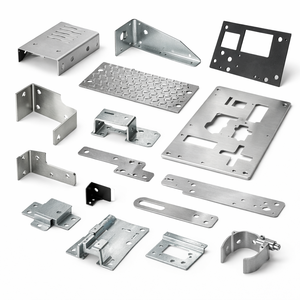
Ambani Metals operates advanced metal forming, stamping, laser cutting, and welding facilities backed by more than 25 years of engineering experience. Because we control the complete manufacturing value chain—from sourcing prime-certified coil and sheet stocks to deep drawing, progressive stamping, and precision assembly—we deliver consistent dimensional fidelity and dependable export logistics.
Precision fabrication in SS304/L, SS316/L, Duplex 2205, Hastelloy, Monel, Inconel, Nickel, and Titanium grades.
High-precision fiber laser cutting systems ensure clean, burr-free orifice edges, preventing unwanted liquid drift.
ISO-compliant inspection routines: positive material identification (PMI), dye penetrant testing, and full water test checks.
Rugged, ISPM-15 compliant seaworthy crating with corrosion-inhibiting wrapping, custom-tagged for simple field assembly.
Our engineering support team works directly from your process data sheets (P&IDs, mass balances, tower datasheets) or shop drawings. Whether you require standard replacement parts for planned shutdowns or custom internals designed for a greenfield petrochemical project, our engineering and export teams provide responsive communication from initial calculation to post-installation inspection.
Review answers to the most common engineering, sizing, and logistics questions submitted by global EPCs, turnaround managers, and procurement officers.
Connect directly with our senior mass transfer engineering team. Send us your column process data sheet, revamping specifications, or equipment drawings for an engineered quotation.