
- +91-9930498858Call / WhatsApp
- [email protected]Email Us
Seamlessly integrated precision hardware, filter elements, and custom deep drawn enclosures built for severe operating environments.
Why maritime, clean-energy, and aerospace engineers throughout the Greater Seattle metro select titanium wire mesh over conventional 316L and duplex alloys.
In the cold, bio-active, and saline waters of Puget Sound and the North Pacific, conventional 300-series stainless steels suffer severe pitting and crevice corrosion under biofilms. Grade 1 & Grade 2 Titanium Wire Mesh establishes an instantaneous, self-healing rutile (TiO₂) passive film that provides near-infinite operational service lives.
Anchored by the Everett and Renton aerospace corridor, local engineering standards require materials with maximum strength-to-weight ratios and high galvanic compatibility with Carbon Fiber Reinforced Polymers (CFRP). Titanium mesh eliminates the catastrophic galvanic battery effect found when carbon fiber touches standard stainless steels.
Washington State's aggressive clean energy transformation and the Pacific Northwest Hydrogen Hub (PNW H2) require electrochemical cells that withstand intense acidic potentials and oxidative oxygen-evolution overpotentials without metal ion poisoning.
Data-driven performance metric analysis comparing Commercial Pure Titanium against standard process alloys.
| Alloy Designation | PREN Value | Chloride Pitting Resistance (Marine) | Density (g/cm³) | Corrosion Rate (Puget Sound Ambient Seawater) | Galvanic Compatibility with Carbon Fiber |
|---|---|---|---|---|---|
| Titanium Grade 1 & Grade 2 (CP) | > 50 (Equivalent) | Exceptional (>100°C resistance) | 4.51 | < 0.0001 mm/year (Immune) | Completely Compatible (Neutral) |
| Stainless Steel 316L (UNS S31603) | 23 - 25 | Susceptible to Crevice Pitting under silt | 8.00 | 0.01 - 0.05 mm/year | Severe Galvanic Corrosion Risk |
| Hastelloy C-276 (UNS N10276) | > 65 | Immune at ambient to intermediate temps | 8.89 | < 0.001 mm/year | Moderate (Requires dielectric barrier) |
| Monel 400 (UNS N04400) | N/A | Good in flowing water, pits in stagnant bays | 8.80 | 0.005 - 0.015 mm/year | High Potential Difference |
Strategic economic and technological trajectories governing metal mesh specification across King, Snohomish, and Pierce counties.
Seattle-area lifecycle engineering groups increasingly measure Total Cost of Ownership (TCO) over 20-year horizons. The recurring downtime costs for dry-docking ferries or replacing clogged 316L heat exchanger screen baskets in Elliott Bay make titanium mesh the definitive cost-negative investment across a 5-year operating window.
With Washington State Ferries transitioning to hybrid-electric propulsion under clean transportation mandates, lightweighting is vital to balance massive battery pack weights. Titanium mesh provides a 43% weight reduction relative to steel mesh with unmatched structural stiffness for maritime HVAC and water intake strainers.
The Washington State Department of Ecology imposes strict restrictions on heavy-metal discharge and toxic biocide usage. Titanium mesh eliminates toxic copper-ion leaching from traditional brass or bronze screens, ensuring full compliance for maritime systems discharging treated ballast back into local waterways.
Established in 1998, we provide deep-level metallurgical traceability, automated weaving, and turnkey delivery from our certified Indian manufacturing plants to West Coast ports.
Every roll of titanium and specialty alloy wire mesh ships with comprehensive EN 10204 3.1 Mill Test Certificates. Full heat-number chemical and mechanical traceability safeguards aerospace and chemical plants from off-spec substitution.
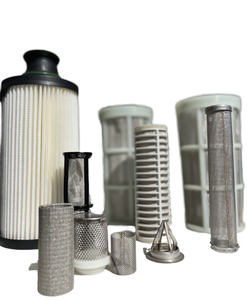
Beyond broadloom mesh rolls, we offer full precision stamping, perforated core fabrication, and deep drawing under one roof. We produce complete cylindrical cartridges, sintered multi-layer laminate packs, and custom-flanged strainer baskets.
Mesh counts, wire diameter tolerances, aperture squareness, and surface purity undergo automated optical profiling and ultrasonic degreasing. Third-party inspection (SGS, Bureau Veritas, Lloyd's) is routinely coordinated at our manufacturing facility.
Engineered ISPM-15 compliant seaworthy wooden crate packaging, desiccant barriers, and vacuum-sealed plastic liners ensure zero surface oxidation or roll distortion across trans-Pacific transit straight into the Port of Seattle and Tacoma terminals.
Direct technical guidance on mesh selection, chemical compatibility, tariffs, and shipping specifications.
Send your mesh count, wire gauge, weave geometry, or engineered drawings directly to our technical sales team for an immediate engineering assessment and competitive quotation.
Send an Inquiry